

National Grid Performance Versus Operational Reality
On paper, Malaysia’s grid performs well. Tenaga Nasional Berhad (TNB) reported a System Average Interruption Duration Index (SAIDI) of 47.88 minutes per customer in 2024, a figure comparable to Italy and France. However, aggregate reliability metrics do not capture the isolated, high-impact events that carry the greatest operational risk. In July 2022, a single substation fault disrupted 10% of Peninsular Malaysia’s power supply, affecting KLIA, RapidKL, and telecommunications networks. In December 2023, a generator failure resulted in an 11-hour outage at the Johor-Singapore Causeway checkpoint. A favourable national average does not equate to protection from the disruptions that materially affect business continuity, which is prompting a growing number of organisations to secure UPS battery backup through established suppliers such as EnergyHub before an outage forces the decision.
Data Centre Expansion Is Intensifying Demand on Power Infrastructure
Structural pressure on the grid continues to build. Johor’s data centre capacity expanded at a compound annual rate of 145% between 2019 and 2024, and TNB projects national data centre demand could reach 5,000MW by 2035, equivalent to nearly a fifth of Peninsular Malaysia’s total generation capacity. This strain is already manifesting in policy: in early 2026, the government paused approvals for new non-AI data centres due to power and water constraints. Reflecting this environment, UPS systems now account for 42% of Malaysia’s data centre power market spend, indicating that operators are prioritising resilience over cost minimisation.
Regional Presence Aligned With Growth Corridors
EnergyHub’s branches in Kuala Lumpur, Johor Bahru, and Penang are positioned directly within the regions absorbing this growth, providing local businesses with a proximate and dependable source of backup power equipment.
Quantifying the Cost of Downtime
The financial exposure associated with unplanned downtime is substantial. Industry estimates place the average cost at $9,000 to $14,000 per minute across organisations, rising to more than $50,000 per minute on active production lines. Measured against this exposure, a properly specified UPS battery backup system from EnergyHub represents a comparatively modest investment.
UPS Technology and Battery Chemistry
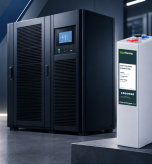
A UPS system pairs a battery with power electronics to sustain equipment operation the instant mains power fails, in accordance with the international standard IEC 62040. Two battery chemistries dominate the market: Valve-Regulated Lead-Acid (VRLA), the most widely deployed and cost-effective option under IEC 60896-21/22, and lithium-ion, increasingly preferred for its smaller footprint and extended service life under IEC 63056. EnergyHub supplies both chemistries for motive and standby power applications, together with the chargers and battery water required to maintain flooded lead-acid systems.
Sector Applications
Data centres, manufacturers, hospitals, telecommunications providers, and logistics or border facilities across Malaysia treat power continuity as essential infrastructure rather than a discretionary investment. EnergyHub supports organisations across each of these sectors.
EnergyHub’s Position Across Malaysia’s Grid Pressure Points
EnergyHub supports the full lifecycle of a UPS battery backup system, from battery selection through to chargers, battery water, and ongoing maintenance services. With branches in Kuala Lumpur, Johor Bahru, Penang, and Singapore, situated in the regions facing the greatest grid pressure, EnergyHub provides businesses with a single, consolidated point of contact for UPS battery backup in Malaysia.
References
- Tenaga Nasional Berhad, Supply Reliability: https://www.tnb.com.my
- Wikipedia, Power outages in Malaysia: https://en.wikipedia.org/wiki/Power_outages_in_Malaysia
- White & Case, What is propelling Malaysia’s data centre boom?: https://www.whitecase.com/insight-our-thinking/what-propelling-malaysias-data-centre-boom
- Rest of World, Malaysia’s new data centers create thousands of jobs, and worries about power and water shortages: https://restofworld.org/2024/malaysia-data-center-jobs-environment/