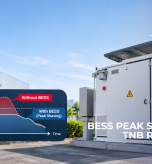


Under TNB’s RP4 tariff, factories and commercial buildings on medium voltage supply pay capacity and network charges per kilowatt of maximum demand, so peak load directly drives the bill. A Battery Energy Storage System (BESS) lowers that peak through peak shaving. Here is how maximum demand charges work in Malaysia and how a BESS reduces them.
What Is TNB’s RP4 Tariff?
RP4 is the electricity tariff structure for Peninsular Malaysia, introduced by the Energy Commission and effective 1 July 2025 to 31 December 2027. Bills are itemised into energy, capacity, network and retail charges. The monthly Automatic Fuel Adjustment (AFA) replaced the six-monthly ICPT.
What Is Maximum Demand?
Maximum demand (MD) is the highest level of electrical demand recorded in a month, measured in kW. TNB defines it as twice the largest kWh supplied during any consecutive 30 minutes. The charge is designed to encourage customers to control their usage at peak hours.
How RP4 Changed Maximum Demand Charges
Under RP4, the previous single MD charge is billed as a capacity charge plus a network charge, both per kW. As of October 2026, the medium voltage electricity tariff in Malaysia applies these rates:
| Tariff | Capacity (RM/kW) | Network (RM/kW) | Total (RM/kW) |
| General | 29.43 | 59.84 | 89.27 |
| Time of Use (ToU) | 30.19 | 66.87 | 97.06 |
Why Peak Demand Matters More Under RP4
Only the highest 30-minute window counts, so one short spike can set the charge for the whole month. On the ToU tariff, only demand recorded Monday to Friday, 2pm to 10pm is charged. Off-peak demand is not charged for non-domestic medium and high voltage customers.
How a BESS Reduces Maximum Demand
A BESS stores energy when demand is low and releases it as your load nears a peak, so less power is drawn from the grid at that moment. This is called peak shaving. EnergyHub’s BESS solutions are designed for commercial and industrial peak shaving, with software to track performance and forecast savings.
How Much Could BESS Peak Shaving Save?
Cutting maximum demand by 100 kW on a medium voltage supply could save between RM107,124 and RM116,472 a year, depending on your tariff:
| Tariff (100 kW reduction) | Monthly saving | Annual saving |
| General | RM8,927 | RM107,124 |
| ToU (peak-period demand) | RM9,706 | RM116,472 |
These figures are illustrations. Actual results depend on your tariff, load profile, system size and project cost.
Where BESS Peak Shaving Fits
Peak shaving is one use among several. EnergyHub’s BESS also supports renewable energy time-shift, critical infrastructure backup, microgrids, utility-scale storage and EV fast-charging infrastructure.
What to Look for in a BESS for Peak Shaving
A battery energy storage system for a factory should be sized to your load profile and peak window. Look for these features, all offered in EnergyHub’s BESS:
- Flexible storage duration, from 2 to 8+ hours
- UL-certified LiFePO4 chemistry with a multi-layered BMS
- Modular expansion
- Installation, 24/7 remote monitoring and maintenance support
Working With Trusted Manufacturing Partners
EnergyHub works closely with established manufacturers, including Powerfit, Sacred Sun, TAB, Eternity, GS Yuasa, Exide, Hoppecke and Solax Power. This lets us recommend and supply the most suitable solution for your application and operating conditions.
Why Choose EnergyHub?
EnergyHub was incorporated in 2014 and operates under ISO 9001:2015 quality standards. From consultation and custom design to installation and support, we plan storage around your site’s actual load.
Contact EnergyHub today to discuss a BESS solution for your factory or commercial building.